
Thanks for your interest in free motoring lessons for learner drivers.
What is the “free tuition” learner driving model?
To explain how it works, some brief background. There are three parts to the process to become an approved driving instructor.
Part 1 is very similar to the regular theory test: multiple choice and the on-screen video game element which will be familiar to all learners.
Part 2 is where the driving instructor in training is examined in their on-the-road skills and judgment – a little like the L-test but with stricter criteria.
Part 3 is the final qualifying test stage, which I am in the process of preparing for. Part 3 involves a lesson of about 50-60 minutes where a learner is taught by the potential (trainee) instructor while being examined throughout by an examiner, who will sit in the back seat and quietly observe the conduct of the lesson from start to finish in order to establish whether the potential instructor has attained the required level, taking into account the pupil’s experience, learning goals and other factors.
It is a requirement to pass Part 3 in order to qualify and be added to the ADI register of approved driving instructors, which is a requirement in order to be able to charge for tuition. Hence the “free” lessons pathway for potential or trainee instructors awaiting the Part 3 test.
The other route to Part 3 is to bond with a franchise operation (typically a large multi-branch established big-brand driving school organisation) providing tuition under a temporary training licence pending the Part 3 exam. Trainee instructors may benefit from being paid for this work, but there are downsides of being effectively under the control of the driving school in a possibly lopsided arrangement in which the trainee instructor will be obliged and likely required to do what best suits the franchise operation, on their terms, and it seems that some feel let down or that they are taken advantage of (or neglected) by the big corporate schools.
So for me, to ensure integrity in the tuition provided, and to maintain control over the type of car and the process of tuition and my own learning and advancement, I decided to go along the “free tuition” route, which I discovered was possible through the generous assistance and guidance provided by a very helpful and knowledgeable ADI based in West Sussex, to whom I am most grateful for being such a valuable mentor and for much useful information.
Providing the free tuition model for learner drivers means that I can build up the required wide range of experience teaching as a trainee or potential instructor to prepare for the part 3 exam, while the pupils learn to drive and benefit from the lessons and driving experience at zero cost. So it is a potential win-win for both the learner and the trainee instructor.
What’s on offer?
Free driving tuition is on offer for a limited number of pupils, for a limited period of time.
The criteria for acceptance as a pupil is as follows:
- Live in or near to Tunbridge Wells, Kent
- Agree to be available – if required (with at least 2 weeks’ notice) – to be the designated pupil for the Part 3 examination lesson (about 1 hour plus travelling time to the Driving Test Centre), typically a weekday early morning or afternoon
- An interest in motoring and in learning to drive a manual car
What sort of car will I learn in?
My preferred manufacturer is BMW because I believe that they make the best cars, from the driver’s point of view. In terms of absolute manufacturing quality, BMWs are probably not in the same zone as Toyota and other Japanese brands, but there is something special and unique about the way a BMW is engineered, the balance of the controls and the way it feels on the road which makes it a particularly special driving machine. It’s also quite heavy (around 1350kg) for a small car, and I believe the comparatively long bonnet and overall size gives it a better safety profile compared to many small hatchbacks, as well as being arguably more comfortable.
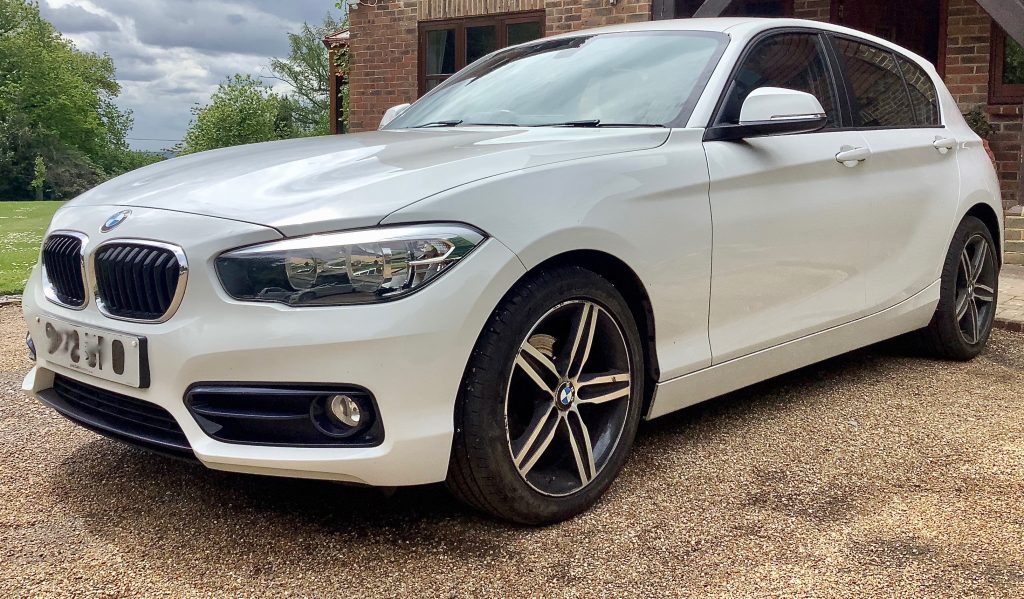
Our car is a 2018 1-series (118i), rear drive, with a six speed manual gearbox; the last of the real “baby beemers” before the inevitable introduction of front drive and default offering of automatic gearboxes along with the modern trend for touch screens, increased digitalisation and computerised automation of the driving experience. Is more tech always better? I’m not sure because it might be OK most of the time but it will always get things wrong. While humans are fallible too, they tend to learn and not keep getting the same things wrong over and again, as computers tend to. While AI is too fuzzy to be reliable, in my view, and the results of relying on AI could be catastrophic.
Consider the fact that a car’s parking sensors can not tell the difference between harmless foliage and a solid brick wall when parking, or imagine the scenario where the computer thinks a black plastic bin-liner suddenly blown by the wind out of a farm field across the road is an “obstacle” and then slams on the brakes or – worse – “auto steers” the car away from a few grammes of scary fluttering plastic into the path of the oncoming 17-tonne bin lorry at 50mph. So, simple and less tech (less to go wrong) is best in my opinion and I like the idea that drivers engage with what they are doing and not be tempted to be mentally “asleep” (inattentive) at the wheel or tempted to use their scrolly because they discover that the car can steer and brake for itself (in certain situations).
Our BMW has dual controls (clutch and brake for instructor’s side) but no other add-ons, no driver aids, no park distance control, no intrusive electronic gadgetry (sat nav aside) and it has a proper hand-brake (I very much dislike electronic parking brakes!).
The little BMW provides a pure and engaging driving experience, despite its modest power output. My view is that most modern cars tend to be burdened with too much “tech” which can often turn into a prop or become an annoyance, and may therefore be a hindrance or distraction that can get in the way of the driver’s sense that they are in full and focused control of the vehicle, and that feeling can sometimes be in conflict with taking control and full responsibility.
I believe that most learners are better off learning in a simpler, more old-fashioned car. New drivers may be at a disadvantage if they learn on nearly-new modern cars with all the external sensor gadgets and computer technology, because as newly qualified drivers, with the high cost of insurance and high price of both cars and routine motor running, they may not be in a position to own or access such an advanced new car for their daily journeys.
New drivers will be also more likely for financial reasons alone to choose an older less technological car, perhaps up to 10 or more years old, and therefore I feel it is best to teach new drivers the essential skills in a simpler, “old school” back to basics way which prepares the new driver to take more responsibility for themselves and others and not rely on distracting dash graphics, radar, cameras and technological bleeps and burps to guide and channel their decisions while they learn, as these interruptions can interfere with the process of properly developing independent skill, judgment, focus and control.
The choice to teach manual rather than automatic is based on a number of factors, some of which may seem contradictory. In my view, automatic cars are safer for learners and new drivers, as they are so much easier, and also are becoming more common on the roads now particularly with more hybrid and electric cars about. Getting to grips with a manual gearbox and old style hand-brake demands a lot more from the pupil and from the instructor, but it’s eventually more rewarding for both and also ensures that the new driver can access a much broader car market when they achieve their test pass, and in future years may find a manual licence a great benefit when needing to rent a van or holiday car abroad. Manual cars tend to be cheaper than auto’s as well, and for smaller hatchbacks, most used models in an affordable price range for car and insurance will usually be manuals, so there are significant benefits of putting in the extra time and effort to learn clutch control and getting to grips with all those hill-starts. One of the issues with getting an automatic-only licence can be that one the new driver is mobile “life just takes over” and although they may be keen to migrate to manual “one day”, the effort of having to go back to arranging driving lessons and the nuisance of interrupting a busy life to book and take another driving test can seem like a retrograde step and therefore be a significant barrier, so inevitably it never gets done and they are stuck with the automatic restriction indefinitely. So although I would always say to any new driver that auto is in my opinion a safer choice, I’d temper that with the fact that in the long run, manual is always better as you’re not restricted. Perhaps the ideal scenario is to learn and pass the test in a manual car, then perhaps look to buy or use an automatic or semi-auto for the first year or two of being a new driver.
Why be a driving instructor?
In 2016 we decided that rather than pay for the school bus to sixth form for our oldest son, then 17, we’d get a little car and I would teach him to drive on the daily journey on school days, given that there was a minimum waiting list of six months or more for a good recommended instructor in our area (my view of driving instructors in general had been tainted by some bad experiences in my youth).
Also, the insurance price was about the same or in fact less than the cost of the yearly bus pass! Given my interest in motoring and roadcraft generally I felt it could work out. That was the start of my teaching journey, and I was pleased that no.1 son gained his driving licence at his second attempt later in 2016. Fast forward to 2025, and I was even more pleased that youngest son achieved a pass on his first attempt with only one “minor” fault! I enjoyed teaching my sons to drive and I believe that they are responsible and safe motorists.
In 2025, without anyone else to teach to drive, I realised that I was missing the driving tuition so I decided to progress through the process of becoming an approved driving instructor. My background is in the creative industry and software development, though more recently in building renovation and hospitality (an antedote to 25 years of desk work).
Teaching, while demanding mentally, can be a great joy and does provide a lot of job satisfaction. If it wasn’t for all the pfaff involved with being a modern teacher, I’d probably be more than happy in a classroom somewhere teaching the basics of PHP and MySQL (although AI seems to have dealt a blow to much of the creative industry, so it may be of little use these days pursuing graphic art or learning to write software or in fact doing anything creative – probably better to learn something practical like plumbing – though I hope in time I am proved wrong!). I am often reminded of an old but enthusiastic school teacher who used to declare that if he didn’t need money to live, he’d teach for nothing, because he enjoyed it! I didn’t quite understand his viewpoint at the age of nine or ten, but now approaching a similar time of life as when he had made those remarks, it resonates more than it did.
Motoring has always been a significant part of my life: I still don’t like jet travel, and always prefer to drive any distance. This is probably because in my childhood we never went on jet plane holidays, even to places like southern Spain and Yugoslavia my dad would load up the Morris Minor and somehow the little 1000cc motor with about 60 horse power always got us there over the Alps or Pyrenees without falling to pieces though it did rattle a lot with its top speed of about 65mph – we had become used to frequent bemused comments at passport control and from the locals about the British in their “little wooden car” (it was a Morris Minor Traveller, a kind of station wagon format with a feature exposed wood frame). I grew up in an area of south London which, at the time, had little in the way of reliable public transport. It is a bit of a cliché (but probably very true) that everyone who lived in south east London in the eighties was obsessed with cars, but motoring was necessary to get around and get on, in the absence of a tube network (there was no extension to the Jubilee line in those days and no under-over-ground fusion until this century), and the overground trains (when they turned up) were generally over-stuffed, unpleasant and slow.
I passed the L-test first time in December 1987 and drove around in a 1969 Hillman Avenger which featured a tacky vinyl roof over a faintly vile faded shade of green. I had bought this car from a school friend who was moving on to the heady joys of an orange 1973 Austin Maxi. The Hillman was a cut-and-shut machine (two write-offs having been frankensteined into one, so the front of one and the rear of another were welded somehow together in the middle – which was still legal then). The “big ends” were on their way out and the car was basically a mobile dustbin in a state of disintegration with more filler than metal on the front wings and cigarette burns on the seats, but the feeling of being mobile in my own car made me deleriously happy.
In the early nineties having secured gainful employment I could afford better cars and had two Mark 1 VW Golfs (an 1100 and then a GTi) and a 1989 Ford Fiesta XR2 which was a hoot to drive despite its astonishing thirst for fuel, but I soon realised that I needed to take to motorcycling as a way to avoid a soul-destroying daily dismal 80-minute commute (each way) into the west end (where I worked, often finishing work late at night long after the transport network shut down, with parking in W1 being outrageously expensive even in those days).
Being a motorcyclist is a useful thing as the added vulnerability and need to anticipate potential danger teaches a lot about defensive driving! I think it would be a good thing for all car drivers to learn how to ride a motorbike of some sort for a time (perhaps before getting behind the wheel) as it very much changes one’s perspective about the importance of reading the road and how we interact with other road users and always trying to be one step ahead in thinking with a view to avoiding potentially dangerous situations – as well as encouraging a little more respect and understanding for motorcyclists and cyclists generally.
Since the eighties I have enjoyed owning and driving around two dozen different cars and motorcycles (not all at the same time). I have driven in excess of half a million miles on roads around the UK, Europe and further abroad, and thousands of miles on tracks (most on the Nurburgring in the 90s and early 2000s before it was ruined by all the Top Gear publicity, after which it became crowded, aggressive and tacky).
In the nineties I was fortunate to take advantage of several sessions of advanced driving tuition from the respected (perhaps legendary) John Lyon, who later wrote an excellent book about his life’s mission of furthering skill and enjoyment in motoring.
I do not present myself as any kind of expert: I have never taken part in or won any competitive motorsport, nor skiied down a couloir or scaled a cliff face.
I have had a reasonable amount of advanced driving tuition on road and track in the last 30 years. I have successfully taught a small number of people to drive – and pass their test – in the last decade. I have nearly four decades overall experience of being a road user as a cyclist, pedestrian (and jogger!), car driver and motorcyclist.
What I have to offer to prospective pupils is based on many years’ personal experience of motoring, a modest track record over the last decade in successfully teaching a small number of learner drivers, an enquiring mind and (I hope) a patient attitude.
I enjoy teaching motoring skills – to drive safely, responsibly and with the attitude that every journey is an opportunity to improve, be smoother, to enhance predictive thinking, and really engage with every aspect of motoring and roadcraft: interaction with, and understanding, of the car, always considering a 360 degree perception of the highway and surroundings, and with “reading the road” at the forefront of the mind.
For motoring as with cooking or carpentry or any skill that you have to concede that one person can never know too much about or be “too good” at, every journey is a unique learning opportunity which can be help unlock improvement, self-awareness and learning, which can in itself be immensely rewarding and enjoyable, even if it’s a drizzly, grey February afternoon heading to Wales on a busy section of the M4. Well, perhaps that’s pushing it a bit.
Everyone can find joy in their motoring, and while this may seem incidental to most routine journeys from A to B, developing an approach of continuous improvement and conscious engagement can enrich every journey and help to bring a positive mindset to all our interactions with others on the road.